
Screen size is the core benchmark for selecting mobile TV carts, and mismatched sizing brings many hidden problems. For small-sized displays, an oversized cart will cause space waste, bulky placement and poor portability. For large ultra-thin TVs, an undersized cart suffers from insufficient load-bearing capacity and narrow base width, making the device prone to shaking or tipping during movement. In commercial scenarios like corporate conferences, campus education and exhibition displays, stable and matched display equipment directly affects on-site presentation effects and equipment safety.
Beyond basic stability, accurate size matching also optimizes viewing angles and cable management. A well-fitted Tv stand cart reserves reasonable space for screen adjustment, heat dissipation and wiring arrangement, avoiding the crowded and messy situation caused by inappropriate size collocation. This is why size matching is always the first step for professional AV equipment deployment.
Standard Matching Parameters for Tv Stand Cart and TV Screens
To help users quickly complete accurate matching, we have sorted out industry-standard size matching data and core cart parameters. All specifications refer to mainstream commercial mobile TV cart manufacturing standards, covering screen adaptation range, load capacity, VESA mounting standards and base dimensions, with high practical reference value.
|
TV Screen Size
|
Compatible Cart Base Width
|
Max Load Capacity
|
VESA Mount Range
|
Applicable Scenarios
|
|---|---|---|---|---|
|
23–43 Inches
|
500–600mm
|
50kg
|
100×100mm – 200×200mm
|
Small meeting rooms, classrooms, home use
|
|
45–65 Inches
|
600–750mm
|
80kg
|
200×200mm – 400×400mm
|
Medium conference rooms, training centers
|
|
70–85 Inches
|
750–900mm
|
120kg
|
400×400mm – 600×400mm
|
Large exhibition halls, auditoriums, business lobbies
|
Practical Matching Rules for Different Screen Sizes
1. Small Screens (23–43 Inches): Prioritize Compact and Flexible Design
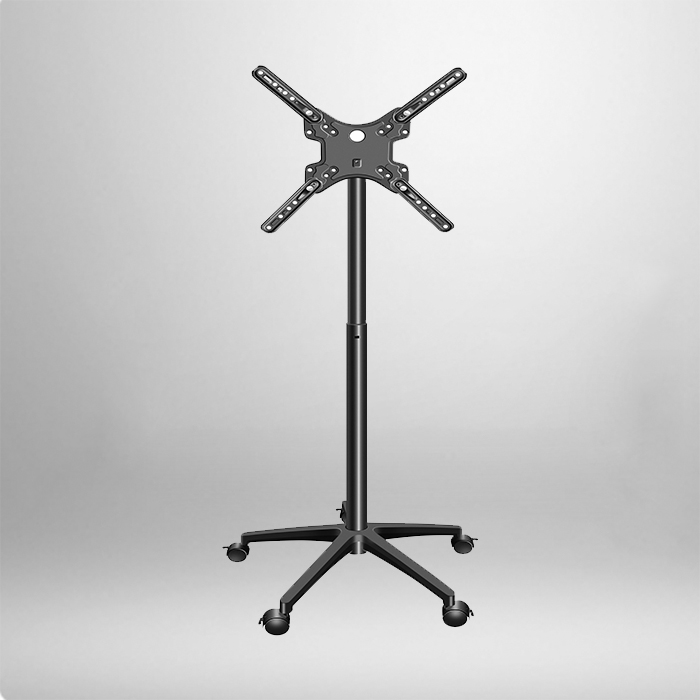
Small-sized TVs and monitors are mostly used for small-space scenarios such as home offices, small classrooms and individual training stations. When matching a Tv stand cart, there is no need for an overly heavy-duty structure. Users should choose compact carts with narrow base, flexible universal casters and adjustable height. This type of cart is lightweight and easy to move, will not occupy extra space, and can meet the needs of frequent position switching. It is worth noting that even for small screens, the VESA mounting hole spacing must be fully matched to avoid unstable installation.
2. Medium Screens (45–65 Inches): Balance Stability and Versatility
45 to 65-inch TVs are the most mainstream specification for commercial office and education scenarios, with high usage frequency and diverse application environments. The matched Tv stand cart needs to balance portability and stability. It is recommended to choose models with widened base, reinforced steel frame and locking casters. The locking wheel design can fix the cart stably during use, preventing sliding, while the adjustable height and tilt angle can adapt to different viewing distances and seating heights. This matching scheme can fully meet the long-term stable use needs of corporate conferences and daily teaching displays.
3. Large Screens (70–85 Inches): Focus on Load Capacity and Anti-Tip Performance
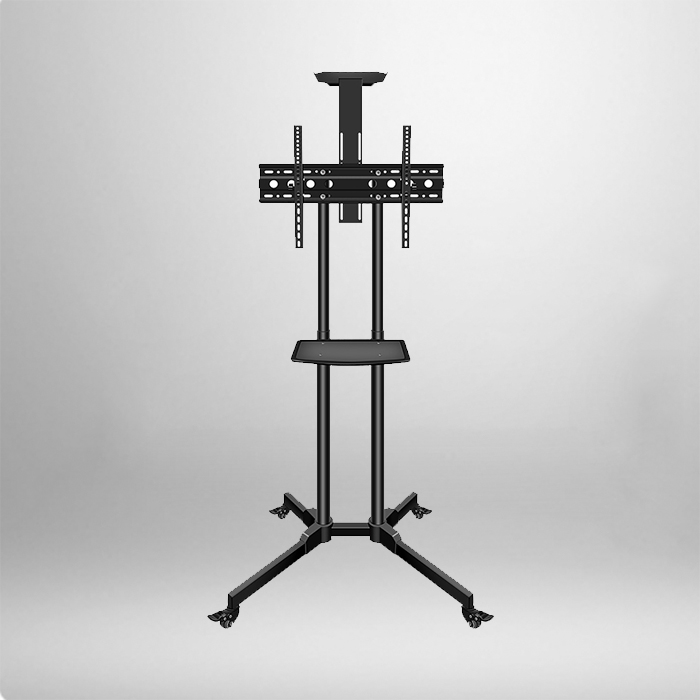
Large ultra-thin screens have a large display area and heavy weight, putting forward higher requirements on the structural strength of mobile carts. When matching, users must prioritize heavy-duty Tv stand cart models with thickened steel frames, widened and deepened bases, and anti-tip auxiliary structures. The super load-bearing design can effectively avoid cart shaking caused by screen weight, and the enlarged base contact area improves ground friction to prevent tipping during pushing and moving. In addition, the ultra-wide VESA mounting range ensures firm installation of large screens and eliminates hidden safety hazards in public scene applications.
Frequently Asked Questions About Tv Stand Cart Size Matching
1. Can one Tv stand cart adapt to multiple sizes of TV screens?
Most standard adjustable carts support a certain range of screen sizes, usually covering 2–3 adjacent size segments. For example, a cart designed for 45–65 inch screens can adapt to all specifications within this range through adjustable VESA brackets and height settings. However, it is not recommended to use one cart for screens with too large size gaps, as it will affect overall stability and safety.
2. Is screen inch the only standard for choosing a Tv stand cart?
No. Screen inch is the basic reference, but users also need to comprehensively consider screen weight, VESA mounting hole spacing, and cart base width. Some ultra-thin large screens have small weight but large size, while a few old thick screens have heavy weight but small inch size. Only combining multiple parameters can complete accurate matching.
3. What risks will mismatched size matching cause?
An undersized cart for a large screen will lead to insufficient load-bearing capacity and poor stability, easily causing screen shaking or tipping. An oversized cart for a small screen will cause space waste, inflexible movement, and inconsistent visual coordination. In addition, mismatched VESA holes will lead to unfixed installation and loose screens, bringing equipment damage risks.
4. Do commercial scenarios need customized Tv stand cart specifications?
For conventional standard screens, universal standard carts can fully meet the demand. For special ultra-wide screens, curved screens or super-large customized displays, it is necessary to select customized cart structures and exclusive mounting accessories to ensure installation firmness and use stability.
Matching a suitable Tv stand cart for different screen sizes is not a complicated task, but it requires attention to detail. Don’t just look at the TV’s inch number blindly; take the time to check the cart’s load capacity, base size and VESA parameters. Whether it’s for home mobile display, daily office conferences or public education and exhibition scenarios, accurate size matching can maximize the service life and use effect of your display equipment, making mobile TV deployment safer and more convenient.