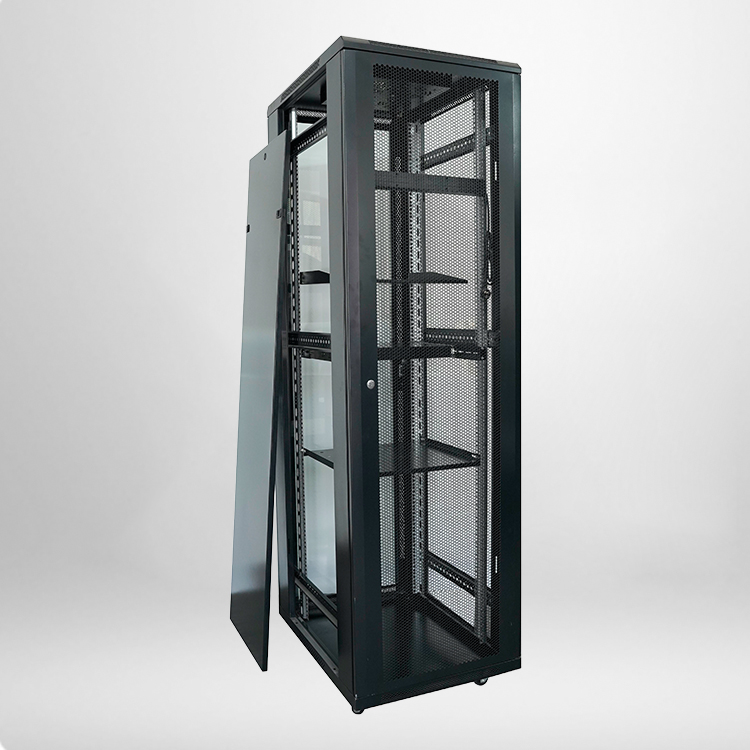
In the current global digital wave, data processing and network transmission have become the core support of social operation, and the importance of the Standing network cabinet as the core carrier of key hardware such as servers, switches, and storage devices is becoming increasingly prominent. This vertical structure network cabinet is not a simple device storage container, but a comprehensive solution that integrates physical protection, environmental regulation, wiring management, and operation and maintenance adaptation. It is widely used in various scenarios such as data centers, enterprise data centers, and telecommunications data centers, laying a solid foundation for the stable operation of network infrastructure.
The birth and development of vertical network cabinets are closely related to the evolution of information technology itself. Early computing devices were scattered and varied in form. With the popularity of standardized 19 inch rack mounted devices such as servers, switches, and storage devices, the demand for unified and intensive installation and management space has become increasingly urgent. Vertical cabinets have emerged as the industry standard solution for efficiently accommodating IT equipment due to their vertically stacked space utilization. Its popularity marks a significant transformation of IT infrastructure from disorganized to standardized and modular management, directly supporting the arrival of enterprise informatization and cloud computing era.
The convenient wiring management and operational adaptability make the Standing network cabinet an important aid in improving operational efficiency. There are usually dedicated vertical cable trays and horizontal cable racks on both sides or at the rear of the cabinet, which can realize the classification and storage of power and signal cables, avoid cable entanglement and confusion, not only facilitate later line inspection and maintenance, but also reduce cable obstruction to airflow and improve heat dissipation effect.
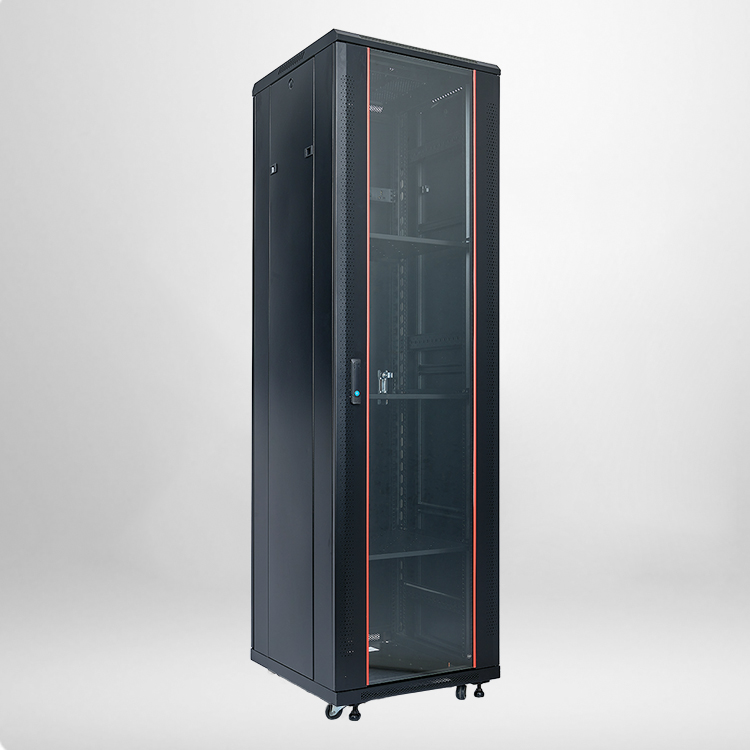
Thermal management is one of the core challenges in the design of vertical network cabinets. The intensive operation of electronic devices generates a large amount of heat, which, if not dissipated, can lead to a decrease in device performance or even malfunction. Therefore, modern cabinets have developed into a part of active cooling systems. In addition to its own optimized ventilation hole layout, it also needs to coordinate with the environmental system of the computer room: from the layout of the front and rear “cold and hot channels”, to the configuration of dedicated cooling fans, air conditioning systems, and even the integration of advanced cold and hot channel closure solutions. The physical structure of the cabinet provides a framework for implementing these heat dissipation strategies, and the efficiency of internal airflow organization directly affects the energy consumption and reliability of the entire IT system.
With the deepening of digital transformation, the application scenarios of Standing network cabinets are constantly expanding, and the adaptation requirements are becoming increasingly diversified. In large data centers, 42U high specification cabinets, with a load-bearing capacity of over 1000kg, have become the core carrier for high-density server deployment. Together with intelligent monitoring systems, they achieve real-time monitoring of parameters such as temperature, humidity, and door magnetic status, assisting in the intelligent operation and maintenance of data centers; In small and medium-sized enterprise computer rooms, 24U-32U small and medium-sized cabinets have the advantage of high cost-effectiveness, meeting the deployment needs of small-scale equipment while balancing cost and basic protection functions; In the edge computing node and outdoor machine room, the cabinet with IP54 or above protection level can resist the impact of humid, dusty and other harsh environments and ensure the stable operation of edge equipment.
Looking ahead, vertical network cabinets will continue to exist as the cornerstone of the IT physical layer. Its development trend will focus more on energy efficiency optimization, intelligent management, and deep integration with modular data center design. With the rise of high-density computing and edge computing, higher requirements are put forward for the cooling capacity, space utilization efficiency and remote operation and maintenance support of the cabinet. As the “backbone” of network infrastructure, Standing network cabinet is continuously adapting to the increasing demand for data volume and computing power through technological innovation, providing a solid guarantee for the high-quality development of the digital economy.