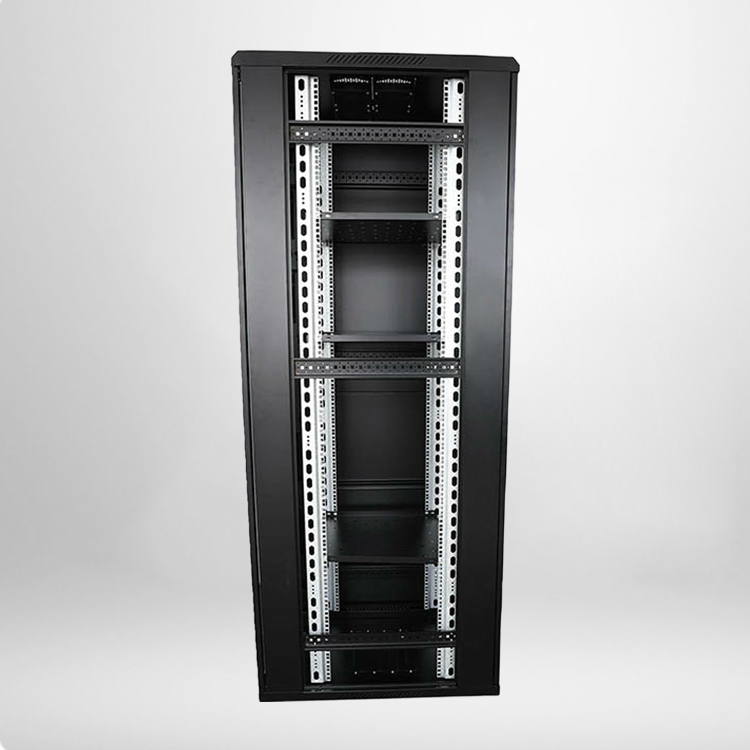
At the tangible level of modern information technology architecture, there exists a framework for building the physical foundation of the digital world – standing server cabinets. These vertical structures, usually presented in black or gray, are neatly arranged on the smooth floor of data centers, forming the most intuitive physical form of digital infrastructure. They are not only containers for devices, but also space solutions for various technical requirements such as computing density, heat dissipation efficiency, and maintainability.
Stability and load-bearing capacity are the core advantages of floor standing server cabinets, and also the key features that distinguish them from other types of cabinets such as wall mounted ones. The floor standing cabinet adopts an integral frame structure, which is mostly made of high-quality cold-rolled steel plates processed through stamping, bending, welding and other processes. The frame has high strength and excellent load-bearing performance, and can stably support the weight of multiple high-density servers and related equipment, avoiding deformation, shaking and other problems during long-term use. Some high-end floor standing cabinets will also optimize their frame structure design, add reinforced beams and columns, further increase their load-bearing capacity, and meet the needs of high-density equipment deployment in large data centers. At the same time, the bottom of the cabinet is equipped with adjustable feet, which can adapt to different ground levels, ensure stable placement of the cabinet, and effectively disperse equipment weight, reducing pressure on the ground.
The main functions of early server cabinets were physical protection and basic organization, while modern vertical cabinets have evolved into intelligent environments that integrate multiple auxiliary functions. The cooling system has evolved from a simple ventilation hole to a precision temperature control solution that includes fan walls, variable speed fans, and even linkage with the computer room air conditioning. Cable management is no longer just about “organizing”, but establishing a visual connection management system through color coding, identification systems, preset paths, and other designs.
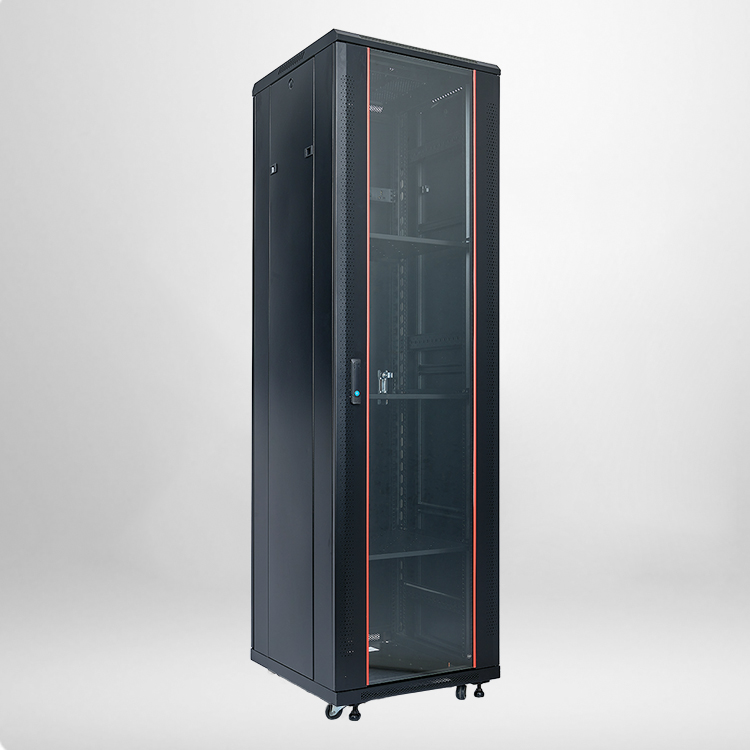
Standing server cabinets are usually designed with fully enclosed or semi enclosed structures, which can effectively block the erosion of internal equipment by external dust, moisture, debris, etc., delay the aging speed of equipment, and extend the service life. In response to electromagnetic interference issues, high-quality cabinets have good electromagnetic shielding performance through reasonable selection of board materials and structural design, which can reduce the impact of electromagnetic radiation generated during equipment operation on the outside world, while avoiding external electromagnetic signal interference with the normal operation of equipment inside the cabinet, ensuring the stability and safety of data transmission. In addition, the security devices such as anti-theft locks and access control systems equipped in the cabinet can effectively restrict unauthorized personnel’s access, reduce the risk of equipment theft and misoperation, and provide comprehensive security protection for core data equipment.
Although data centers are the most typical application scenario for vertical server cabinets, their forms have evolved into many variants according to different deployment environments. The model with adjustable depth can meet the needs of equipment of different sizes. The version with silent design is suitable for office environments or edge computing scenarios. The ruggedized cabinet meets the special requirements of industrial environments.
In recent years, with the rise of edge computing, the compact vertical cabinet has gained new attention. These solutions with a height of less than 20U can be deployed in branch offices, retail locations, or factory workshops, pushing computing resources to the forefront of data generation. Despite the reduction in size, these cabinets still inherit the core design principles of standard cabinets: modularity, maintainability, and effective heat management.
As the core support carrier for large-scale data deployment scenarios, standing server cabinets have become an important component of digital infrastructure construction due to their stable structure, comprehensive protection, efficient heat dissipation, and convenient deployment capabilities. Against the backdrop of accelerated digital transformation, it will continue to improve performance through technological innovation, providing a more solid guarantee for the safe and efficient operation of various large data centers and core data centers, and assisting in the high-quality development of the digital economy.