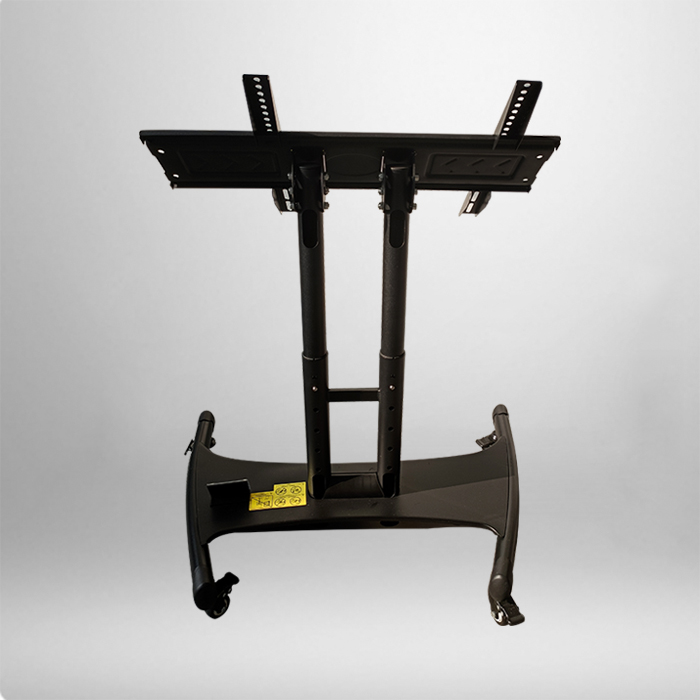
Cheap, lightweight mobile TV carts often break easily with frequent daily use, causing extra replacement costs and project delays. That’s why most professional buyers turn to a heavy-duty TV stand cart for long-term commercial and educational deployment.
Unlike regular household TV trolleys built for occasional movement, heavy-duty models are engineered for high-frequency public use. They need to hold large-screen displays securely, withstand constant pushing and moving, and stay stable in busy classrooms, conference halls and corporate training rooms. Picking the right model is not just about matching screen sizes, but about balancing safety, durability and practical functionality for project-based bulk purchases.
Key Standard Specifications of Qualified Heavy-Duty TV Stand Cart
For B-end project procurement, parameter standardization is the core basis for judging product quality. Many low-quality products on the market cut corners on materials and load-bearing structures, which cannot adapt to long-term high-intensity use in education and corporate scenarios. The following are industry-recognized standard parameters for premium heavy-duty models, which serve as an important reference for bulk ordering and project inspection.
|
Specification Item
|
Standard Parameter
|
Project Application Value
|
|---|---|---|
|
Applicable Screen Size
|
32–86 Inch LED/LCD Screens
|
Covers most classroom and corporate display equipment
|
|
Maximum Load Capacity
|
120KG Static Load
|
Supports thick commercial smart screens and interactive panels
|
|
Height Adjustment Range
|
1200mm–1800mm
|
Adapts to standing meetings and student viewing heights
|
|
Main Frame Material
|
1.2mm Thick Cold-Rolled Steel
|
Anti-deformation, durable for long-term frequent movement
|
|
Caster Configuration
|
4 Silent Lockable Universal Wheels
|
Smooth movement, fixed positioning, floor protection
|
|
Cable Management Design
|
Built-in Cable Holes & Wire Grooves
|
Neat wiring, compliant with corporate and campus safety standards
|
These standardized configurations distinguish professional heavy-duty products from ordinary household trolleys. When evaluating suppliers for group projects, procurement teams can directly use these parameters as screening thresholds to eliminate unqualified products and ensure project delivery quality.
Core Selection Criteria for Education and Corporate Project Use
1. Prioritize Load-Bearing Stability and Structural Safety
Safety is always the top priority for public space facility procurement. In K12 classrooms, university training rooms and corporate conference centers, display carts are moved dozens of times every week. A shaky frame or insufficient load-bearing capacity may cause screen tilting or even falling, leading to equipment damage and potential personal safety risks.
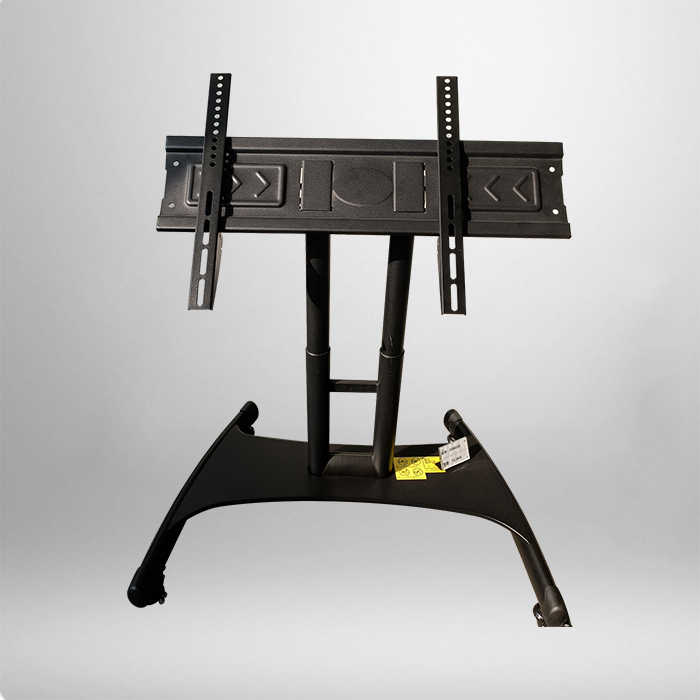
A reliable heavy-duty TV stand cart adopts an integrated thickened steel frame and reinforced base structure. The widened base effectively lowers the center of gravity, ensuring no shaking even when fully loaded with large screens. For project bidding and bulk purchasing, structural stability should always be the first evaluation indicator, far more important than low unit prices.
2. Verify Scenario Adaptability and Mobility Performance
Education and corporate scenarios have strict requirements for equipment flexibility. Classroom teaching needs frequent movement between different classrooms, while enterprise meetings require flexible transfer between multi-functional halls and office areas. Poor wheel quality will cause stuck movement, floor scratches or loud rolling noise, affecting teaching and office environments.
High-quality heavy-duty models are equipped with wear-resistant silent casters with dual locking functions. The wheels can slide smoothly on wooden floors, cement floors and carpet edges, and the lock design can fix the cart stably in place to avoid accidental sliding during use. This flexible mobility greatly improves the reuse rate of display equipment in the whole project.
3. Focus on Standardized Safety and Maintenance Design
Campus and enterprise facility management has unified requirements for equipment wiring, fire safety and daily maintenance. Ordinary mobile carts lack cable management structures, resulting in scattered power cords and data lines, which are not only unsightly but also prone to tripping hazards and potential circuit safety risks.
The professional TV stand cart is designed with standardized cable routing holes and hidden wire grooves, which can organize all lines in order. In addition, the detachable structural design facilitates later equipment maintenance, screen replacement and cart cleaning, reducing the long-term operation and maintenance cost of enterprise and campus facilities.
Common FAQs for Heavy-Duty TV Stand Cart Project Procurement
1. What is the core difference between heavy-duty and ordinary mobile TV carts?
Heavy-duty models adopt thickened steel frames and reinforced base structures, with higher load-bearing capacity and anti-shake performance. They are designed for high-frequency commercial and educational use, while ordinary lightweight carts are only suitable for occasional household use and cannot withstand long-term frequent movement.
2. What screen sizes are most compatible for educational and corporate projects?
Most campus and enterprise projects adapt to 55-inch to 75-inch smart screens. The universal 32–86 inch compatible design of standard heavy-duty carts can fully cover mainstream equipment models, reserving enough space for subsequent equipment upgrading and replacement.
3. Are lockable casters necessary for public scenario deployment?
Absolutely necessary. Lockable wheels can fix the cart steadily during classes or meetings to avoid accidental sliding. It is a basic safety configuration required in most school facility bidding standards and corporate office equipment specifications.
4. Can heavy-duty TV carts adapt to different floor environments?
Qualified heavy-duty products are equipped with multi-scenario adaptive silent casters, which can move stably on cement floors, wooden floors and short-pile carpets without jamming or scratching the ground, meeting the diversified layout needs of modern campuses and office buildings.
5. What factors affect the service life of project-purchased TV carts?
Frame material thickness, welding process, caster wear resistance and structural anti-rust treatment are the key factors. Standard heavy-duty products with complete surface spraying and thick steel structures can serve more than 5 years in public scenarios, reducing repeated procurement costs for enterprises and schools.