
Many people assume all mobile TV carts look and work the same. But in real office project applications, small design differences can determine whether the equipment is convenient, durable, and suitable for long-term commercial use. This article breaks down the most valuable functional designs that make a high-quality TV stand cart a top pick for office construction and renovation projects.
1. Height Adjustable Structure for Multi-Scenario Office Use
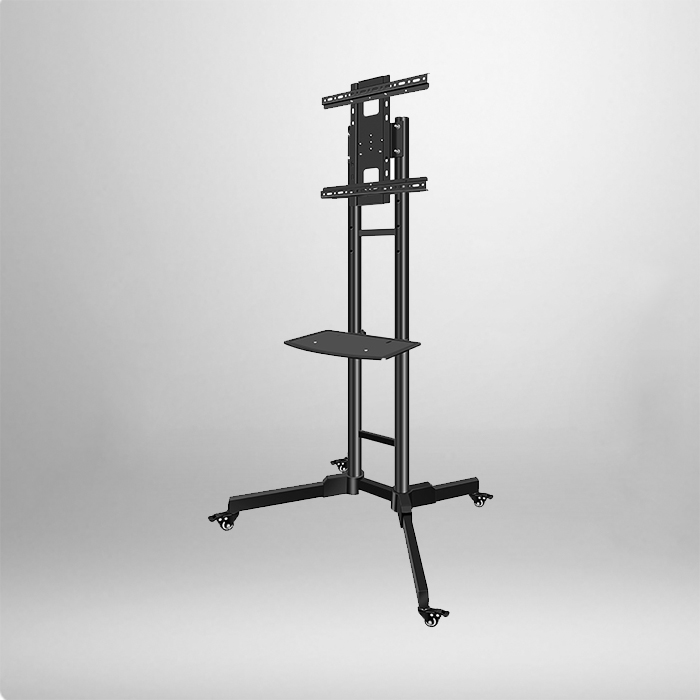
One of the most practical and sought-after designs for office-grade TV stand cart is the stepless height adjustment function. Office spaces host diverse activities, including daily team meetings, client presentations, employee training, and video conferences. A fixed TV height often causes viewing discomfort, affecting communication efficiency.
Premium office models adopt manual crank or pneumatic lifting structures, allowing users to adjust the screen height freely from standing presentation mode to sitting viewing mode. This flexible design adapts to different crowd heights and meeting scenarios, solving the viewing dead zone problem in medium and large conference rooms. Unlike household carts with simple fixed holes, commercial adjustable structures feature stable lifting synchronization and anti-shake performance, ensuring the screen remains steady during height changes.
2. Reinforced Load-Bearing & Anti-Shake Frame Design
Office projects prioritize durability and safety far more than personal household use. Large-size smart TVs and interactive displays widely used in offices weigh far more than traditional home televisions, which puts higher demands on the load-bearing capacity of the TV stand cart.
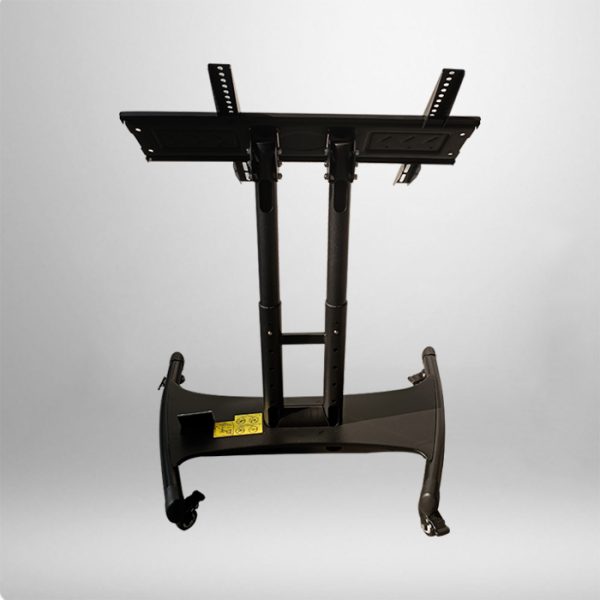
High-quality office cart frames are usually made of thickened cold-rolled steel, with integrated bending and welding processes to avoid structural deformation after long-term load-bearing. The overall stable triangular mechanical structure effectively reduces screen shaking during movement or slight collision. This design is critical for office scenarios, as unstable display equipment will affect meeting experience and even cause safety hazards.
3. Silent Universal Wheel & Brake Mobile System
Mobility is the core advantage of a TV stand cart, and the wheel design directly determines its office usability. Traditional ordinary casters produce harsh friction noise when pushing, which easily disturbs office order and affects quiet working environments.
Professional office configurations use high-density silent rubber universal wheels, which feature wear resistance, skid resistance, and mute movement. Each wheel is equipped with an independent foot brake device. After moving the cart to a designated position, users can lock the wheels quickly to prevent sliding or tilting. This design supports flexible equipment scheduling: the cart can be moved to the conference room for meetings in the morning, transferred to the training room for skill teaching in the afternoon, and stored in the corner when not in use, greatly improving office space flexibility.
4. Humanized Cable Management & Storage Design
Messy data cables, power cords, and charging adapters are a common pain point for office display equipment. Ordinary mobile carts lack cable management structures, leading to scattered wires, easy dust accumulation, and even potential leakage and tripping risks.
Most office-specific TV stand cart products are equipped with built-in cable holes, hidden cable grooves, and layered storage trays. The independent storage layer can place set-top boxes, power adapters, speakers, and other office accessories. The standardized cable management design keeps the entire equipment neat and tidy, conforming to the minimalist and orderly decoration style of modern offices, while also facilitating daily equipment maintenance and circuit inspection.
Core Parameter Reference of Office-Grade TV Stand Cart
The following standardized parameters are widely adopted in mainstream office engineering projects, which can serve as a reliable reference for procurement and design selection:
|
Parameter Item
|
Office Standard Specification
|
Application Advantage
|
|---|---|---|
|
Applicable TV Size
|
32-86 inches
|
Covers small meeting rooms to large multi-functional halls
|
|
Max Load Capacity
|
80-120KG
|
Suitable for heavy-duty commercial displays and interactive screens
|
|
Lifting Height Range
|
1200-1800mm
|
Adapts to sitting and standing viewing scenarios
|
|
Wheel Configuration
|
4 silent universal wheels with dual brakes
|
Mute movement, stable positioning, no floor damage
|
|
Frame Material
|
1.2-1.5mm thick cold-rolled steel
|
Anti-rust, anti-deformation, long service life
|
FAQs About Office TV Stand Cart
1. Is a height-adjustable TV stand cart necessary for ordinary small offices?
Yes, it is highly recommended. Small offices usually have multi-functional spaces that integrate meetings, training, and communication. The adjustable height design can adapt to different usage needs, avoiding the single viewing angle problem of fixed stands and improving overall office comfort.
2. Can the TV stand cart move freely on wooden and carpeted office floors?
High-quality office models with silent enlarged rubber wheels can move smoothly on wooden floors, tile floors, and short-pile carpets. It is worth noting that overly thick long-pile carpets will slightly affect the pushing smoothness, which is a minor limitation of all mobile cart products.
3. How to maintain the office TV stand cart to extend its service life?
Daily maintenance is simple and feasible. Regularly clean the wheel surface of dust and sundries, check the tightness of frame screws every six months, and avoid long-term overload placement. Routine maintenance can effectively prevent jitter and jamming, ensuring stable long-term use in office projects.
4. What is the biggest difference between office and household TV stand cart?
Office models focus on load-bearing stability, mobile silence, safety braking, and standardized cable management, adapting to high-frequency repeated use. Household products are more lightweight with simple functions and cannot meet the durability and safety standards of commercial office scenarios.